
 info@lgaauditing.ae

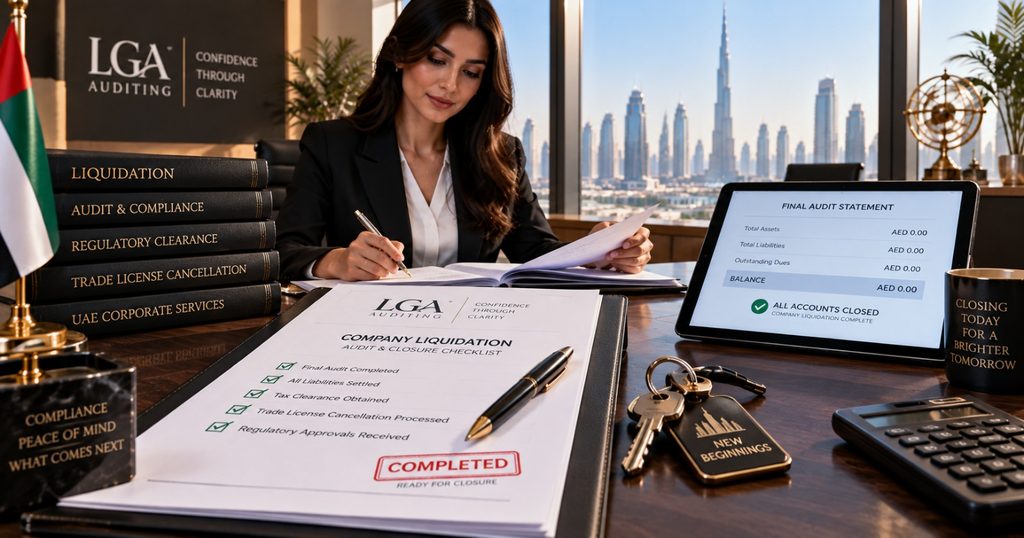
Completing a formal company liquidation audit Dubai is a legal prerequisite for any business owner seeking to cancel a commercial trade license and dissolve a corporate structure cleanly in the United Arab Emirates. Simply ceasing day-to-day operations or letting an annual license expire without formal winding up creates compounding legal fines, blocks corporate bank accounts, and exposes shareholders to ongoing personal liabilities.
Under UAE Ministry of Economy regulations and Federal Decree-Law No. 32 of 2021 on Commercial Companies, limited liability companies (LLCs) and free zone entities must appoint an accredited, registered liquidator. The liquidator audits company accounts, oversees the settlement of corporate debts, ensures employee gratuities are paid, and produces the official final audit report required by economic departments to strike the entity off the commercial register.
Closing an entity requires careful coordination between municipal licensing bodies, immigration channels, and the Federal Tax Authority (FTA). Here is a complete operational guide to navigating the liquidation process efficiently.
Why a Company Liquidation Audit Dubai Is Legally Required
When an LLC or free zone company dissolves, the state must ensure that third-party obligations are not left unaddressed. Creditors, utility providers, staff members, and tax authorities hold legitimate financial claims against the company balance sheet.
A certified company liquidation audit dubai provides formal legal assurance that:
- All corporate bank accounts have been reconciled and closed with zero remaining balance.
- Staff end-of-service gratuities, outstanding salaries, and repatriation dues have been paid in accordance with UAE Labour Law.
- Commercial debts to suppliers, landlords, and institutional lenders have been fully settled or formally waived in writing.
- All commercial assets, stock inventory, and equipment have been liquidated or transferred at verified fair market value.
Without a final audit report signed by an approved auditor, the Dubai Department of Economy and Tourism (DET) will not issue the final cancellation certificate.
The Step-by-Step Procedure to Liquidating a UAE Company
The dissolution of a corporate entity in the UAE follows a strict two-stage regulatory sequence. Attempting to skip steps or cancel visas prematurely often stalls the entire process.
Stage 1: Shareholder Resolution and Liquidator Appointment
The company shareholders must pass an official resolution resolving to dissolve the business and appoint an approved audit firm to act as the official liquidator. For mainland LLCs, this resolution must be notarized through a UAE Public Notary or attested digitally. Once notarized, the resolution along with the liquidator’s formal letter of acceptance is submitted to DET (via the Invest in Dubai portal) to receive the initial dissolution certificate.
Stage 2: The Mandatory 45-Day Creditor Notice Period
Upon receiving initial approval, the liquidation notice must be published in two local Arabic newspapers. Under UAE Commercial Companies Law, this initiates a mandatory 45-day standstill window. This period allows any outstanding creditors, vendors, or individuals holding unpaid claims against the company to step forward and submit written demands to the appointed liquidator.
Stage 3: Clearance from Federal and Municipal Authorities
While the 45-day notice runs, management and the liquidator must systematically cancel operational accounts and gather final clearance certificates from every regulatory touchpoint:
- Ministry of Human Resources and Emiratisation (MOHRE): Cancel all employee work permits and clear the company establishment card.
- General Directorate of Residency and Foreigners Affairs (GDRFA): Cancel all partner and employment residency visas under the trade license.
- Federal Tax Authority (FTA): File final tax returns and complete formal deregistration for VAT and Corporate Tax.
- Dubai Customs: Settle outstanding duties, clear pending import manifests, and cancel the customs code.
- Utility Providers & Telecom: Settle final bills and obtain clearance letters from DEWA, Etisalat/du, and the commercial landlord.
Stage 4: Issuance of the Final Liquidation Audit Report
Once the 45-day notice window expires without unresolved creditor claims, the approved auditor conducts the final accounting review. The firm issues the official Statement of Affairs and the Final Liquidation Report. This report, accompanied by all government clearance certificates, is submitted to DET or the relevant Free Zone Authority to pay final government fees and collect the Trade License Cancellation Certificate.

Mainland (DET) vs. Free Zone Liquidation: Key Differences
While the underlying accounting principles remain identical, procedural timelines and audit rules differ noticeably depending on the corporate jurisdiction:
| Feature | Dubai Mainland (DET / DED) | Major Free Zones (DMCC, JAFZA, DDA) | Northern Emirates Free Zones (Shams, RAKEZ) |
|---|---|---|---|
| Final Audit Requirement | Mandatory for all LLCs and foreign branches; optional for sole establishments. | Strictly mandatory; must be conducted by an approved free-zone registered auditor. | Mandatory for standard LLC structures; simplified balance sheets accepted for select licenses. |
| Creditor Notice Window | 45 days in two local Arabic newspapers. | Typically 14 to 30 days published in local gazettes or free zone web portals. | 14 to 15 days electronic portal announcement. |
| Bank Account Letter | Mandatory zero-balance bank closure confirmation letter. | Official bank closure confirmation letter required before final sign-off. | Bank account closure certificate or shareholder indemnity undertaking. |
| Average Timeline | 60 to 90 days from resolution to cancellation. | 45 to 60 days depending on visa cancellation speed. | 30 to 45 days for clean balance sheets. |
Clearing the FTA: VAT and Corporate Tax Deregistration Rules
One of the most frequent reasons for delayed company closures in recent years is unresolved standing with the Federal Tax Authority. A commercial license cannot be canceled while an active tax registration number (TRN) remains in place.
Under UAE tax regulations, company dissolution triggers mandatory deregistration for both Value Added Tax and Corporate Tax via the EmaraTax portal:
- VAT Deregistration: Must be submitted within 20 business days of ceasing taxable operations. Management must file a final VAT return reconciliating any remaining output tax on assets retained by partners.
- Corporate Tax Deregistration: Under Federal Decree-Law No. 47 of 2022, taxable entities undergoing dissolution must submit an application for Corporate Tax deregistration within statutory time limits. The entity must file a final tax return covering the period up to the dissolution date and settle all tax liabilities.
Failing to submit tax deregistration on time triggers administrative fines ranging from AED 1,000 up to AED 10,000 per violation. Retaining specialized liquidation report services dubai ensures that your tax filings, asset disposals, and final clearance applications proceed in lockstep with the municipal closure timeline.
The Bank Account Closure Dilemma (And How to Resolve It)
Business owners frequently run into an operational deadlock with corporate banks during liquidation. Licensing authorities often demand a bank account closure certificate before issuing the final cancellation certificate. Meanwhile, commercial banks refuse to close an account until the final cancellation certificate is issued, or they freeze accounts the moment newspaper notices appear.
To avoid this deadlock:
- Do not notify the bank prematurely before all outstanding operational collections, customs refunds, and payroll transactions are completed.
- Leave sufficient funds to clear final bank administrative charges, trade finance obligations, and utility debits.
- Instruct the bank to issue an official “Account Balance Certificate” showing a zero balance and stating that the account is marked for closure upon license cancellation.
- The appointed liquidator incorporates this bank clearance confirmation directly into the final Statement of Affairs.
Inside the Liquidator’s Statement of Affairs
During a company liquidation audit dubai, the appointed audit partner does not perform a simple surface-level review. The auditor inspects ledger accounts in detail to verify that no residual assets or liabilities remain unaccounted for.
The audit review focuses on four primary accounting areas:
- Fixed Assets and Inventory Disposal: Verifying that machinery, vehicles, office furniture, and stock have been sold at documented market rates, and that proceeds have been deposited into company accounts to pay creditors.
- Intercompany Loan Reconciliations: Ensuring that loans between related sister entities or shareholder balances are formally settled or written off through bilateral board waivers.
- Employee Gratuity and Final Settlements: Auditing signed wage protection system (WPS) records, end-of-service calculation sheets, and signed release letters confirming zero pending labor claims.
- Contingent Liabilities and Bank Guarantees: Ensuring that all performance bonds, letters of credit, and corporate guarantees issued to third parties have been formally released by the bank.
To prepare your books for this review, work with an experienced auditing and assurance firm to reconcile your ledgers before the liquidator begins their formal verification.
The Hidden Risks of Abandoning an Inactive Trade License
Some business owners assume that if a business runs out of capital or ceases activity, they can simply walk away, ignore renewal notices, and let the license expire. In the UAE, this approach carries severe long-term personal consequences.
When a commercial license lapses without formal liquidation:
- Automatic Penalty Accumulation: Economic departments assess recurring late renewal fines of AED 200 to AED 500 per month, which accumulate indefinitely against the license file.
- Shareholder and Director Blacklisting: Corporate registry systems flag the passport numbers of all registered partners. This blocks partners from incorporating new companies, acting as directors, or renewing existing personal residency visas.
- Bank Account Freezes: UAE banks automatically freeze corporate accounts upon license expiry, locking any remaining operating capital until formal liquidation occurs.
- Immigration Bans: Uncancelled employee visas linked to the expired license file can lead to absconding penalties and administrative travel bans on the local partner or managing director.
Executing an orderly voluntary liquidation with an approved audit partner permanently discharges shareholder liability and allows founders to exit the UAE market or start new commercial ventures with a completely clean regulatory record.
Frequently Asked Questions
How long does the entire company liquidation process take in Dubai?
For a standard mainland LLC, the entire process takes between 60 to 90 days. This includes shareholder resolution notarization (1 to 2 weeks), the mandatory 45-day newspaper creditor notice period, and final audit clearance and license cancellation (2 to 3 weeks). Free zone closures can sometimes be completed within 30 to 60 days depending on the specific zone’s gazette notice rules.
Can a company close down if it still has outstanding debts in the UAE?
No. A company cannot complete voluntary liquidation until all corporate debts are either settled in full or creditors provide written, notarized letters waiving their claims. If an entity cannot pay its debts and creditors do not agree to a settlement, the company must enter court-supervised commercial insolvency under the UAE Bankruptcy Law rather than administrative voluntary liquidation.
Is a liquidation audit mandatory for a sole establishment in Dubai?
Generally, no. Sole establishments owned by an individual on the mainland can often cancel their trade license through DET without an independent liquidation audit, as the owner bears direct, unlimited personal liability. However, limited liability companies (LLCs), branches of foreign companies, and free zone entities are legally required to submit an approved liquidator’s final audit report.
What happens to the company’s remaining cash balance during liquidation?
Once all government fees, taxes, employee gratuities, and third-party debts are paid in full, any remaining capital in the company bank account is distributed among the partners in proportion to their shareholding percentages as specified in the Memorandum of Association (MOA).
Plan an Orderly, Compliant Exit for Your Business
Closing a business in the UAE requires structured accounting oversight, precise regulatory timing, and proactive tax settlement. Appointing an experienced auditing firm ensures your liquidation audit passes DET scrutiny without unnecessary delays or compounding penalties.
LGA Auditing is an approved liquidator registered across Dubai Mainland and UAE Free Zone authorities. We manage your liquidation audit, draft the official Statement of Affairs, and coordinate your complete FTA tax deregistration from initial notice to final license cancellation.